
HRAP Fellow Reframes African Feminist Leadership at Columbia Panel
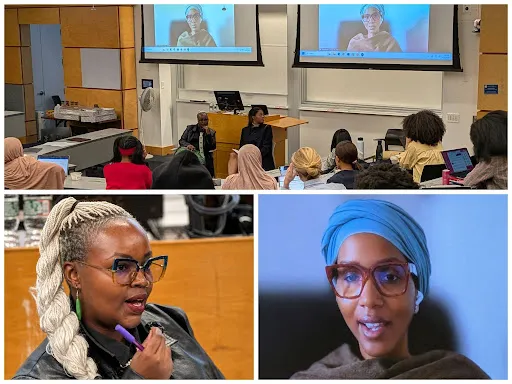
The gender hierarchies prevailing across much of Africa today were shaped by colonial encounter, not indigenous tradition. That was the working premise that HRAP advocate Nyawira Wahito brought to a Columbia symposium on Friday, April 24, where she argued that the work of African feminist liberation is closer to recovery than to reform. The symposium asked how rights frameworks become real institutions, curricula, and care structures.
The panel paired Wahito, Executive Director of the Resource Center for Women and Girls in Machakos, Kenya, with Shudufhadzo Musida, the South African author, mental health advocate, and United Nations Population Fund Global Champion for Women and Girls. The moderator from the African Development Group at Columbia University led the discussion. The event, "She Who Rises: African Women Shaping Futures," drew students, fellows, and affiliates of both the Institute for the Study of Human Rights and the African Development Group to Uris Hall on Columbia's Morningside campus.
"The way we understand gender roles now is very much a colonial concept," Wahito told the audience. She recalled the matrilineal traditions of the Ashanti of Ghana and her own Kikuyu community in Kenya. She also invoked Wangu wa Makeri, the only woman to serve as a colonial-era chief in Murang'a, the central Kenyan region historically regarded as the ancestral home of the Kikuyu people. Decolonizing gender, she argued, is not a matter of importing a Western analytic. It is the recovery of a vocabulary that colonial governance worked to suppress.
Wahito's biography is itself an argument for the work. She first encountered the Resource Center for Women and Girls as an adolescent participant in its programs and now serves as the organization's Executive Director. The curriculum, she explained, begins by interrogating what she calls "the noise," the inherited messages that link an African girl's worth to her productivity and her silence. The Center's residential retreats are designed as deliberate counterpoints, and participants are not permitted to undertake domestic chores. "Resting is a radical act of feminism," she said. "You are allowed joy. You're allowed well-being. You're allowed care." The organization has reached girls in all 47 of Kenya's counties and is a recipient of the With and For Girls Award.
Musida, joining remotely, argued that mental health is not a side issue in development work but central to it. She recalled the launch of Mindful Mondays during the COVID-19 pandemic, an Instagram series produced with the South African Depression and Anxiety Group (SADAG). According to Musida, calls to SADAG's national helpline doubled during the series' run, which has since grown into a podcast. She is also the author of Shudu Finds Her Magic, a children's book published by Jacana Media in six South African languages, designed to introduce mental health literacy in the languages children speak at home.
Her remarks on leadership engaged directly with empirical research. She referenced the McKinsey Health Institute's 2023 report Reframing Employee Health, which documents that women report higher rates of occupational burnout than men, and invoked the World Health Organization's definition of health as a complete state of physical, mental, and social well-being. "You can't lead without a sense of psychological safety for those you lead and for yourself as well," she said.
Both speakers returned in closing to the political significance of joy. Wahito described the growing visibility of Kenyan women in public spaces of leisure as a refusal to await permission. "Women are not waiting," she said. "They are taking and they are owning those spaces." Musida drew on the Toltec writer Don Miguel Ruiz's concept of auto-domestication, the idea that women internalize social rules until compliance feels natural, and argued that joy must be cultivated early. "We've never been seen as joyful, but more as resilient," she said of Black women.