
Visiting Scholars
Overview
The Institute for the Study of Human Rights welcomes scholars engaged in research on a wide range of human rights topics. The Visiting Scholars Program is designed to provide visiting scholars access to the rich research and educational community at Columbia. Situated in New York City, scholars have the chance to explore the city’s range of NGOs, United Nations bodies, and significant research universities and institutes.
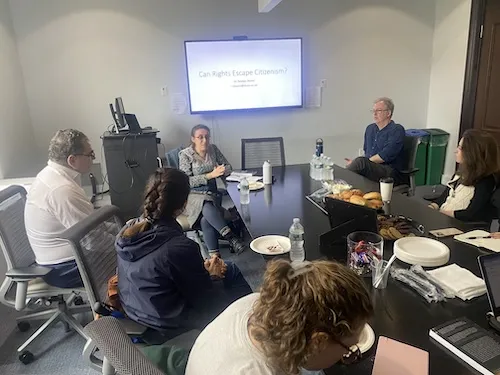
At Columbia, visiting scholars have full access to all of our many libraries, the Human Rights Web Archive and the Center for Human Rights Documentation & Research. The Authur W. Diamond Law Library Research Guide for international human rights research provides scholars additional legal research support and resources, as well as the Human Rights Institute at Columbia Law School, which offers a range of engaging events every semester. Scholars are also connected to the expert faculty at the Institute for the Study of Human Rights who are actively engaged in research and teaching of human rights topics, and are encouraged to audit human right-related courses and attend the monthly Human Rights Seminar.
Previous visiting scholars have conducted research on a breadth of research topics. Examples of past research projects include:
- The development of an electronic exhibit relating to the Archive Legacy of Conflict in South Asia at the Columbia University Libraries
- The creation of a model for social and environmental mitigation with indigenous communities to move away from confrontation, conflict, and hostile development towards conservation and conversation
- An exploration of Roma identity in the global context
- Research into counter-narratives of female delegates of the 1948 drafting of the UDHR
- An investigation of the genealogy of human rights theory, practice and their claim to universality, particularly in relation to their visual representation in exhibitions, museums and digital media.
Becoming a Visiting Scholar
The Institute for the Study of Human Rights welcomes scholars wishing to engage in research in the area of human rights. The Visiting Scholars Program is designed to link visiting scholars with the Columbia community by providing connections to faculty members and encouraging participation in conferences and seminars. Applicants are expected to demonstrate a strong intellectual link to the Institute as well as a clearly defined program of research and/or study while in residence. Applicants should hold a PhD, be ABD, or have professional experience in addition to an MA or comparable degree.
Check here for selected biographies of previous scholars.
While in residence, Visiting Scholars are expected to:
- Participate in the intellectual life of Columbia University by attending conferences and seminars
- Present at least one talk per semester
- Meet with a faculty sponsor regularly
- Provide the Institute with copies of any publications that result from their time at Columbia, and acknowledge the support of the Institute for the Study of Human Rights within those publications.
- Provide a final report detailing what was accomplished during residency (e.g., established connections, written publications, research conducted, courses audited). This report must be submitted before departure from the Institute for the Study of Human Rights
Visiting scholars are encouraged to audit courses and to participate in the Human Rights Seminar, a monthly meeting held through the University Seminars that features research on human rights by an interdisciplinary set of scholars.
Visiting Scholars can be affiliated with the Institute for up to one year. This affiliation entails:
- Access to Columbia University facilities and libraries
- Faculty advisement
- Participation in Institute-related events
Please note: The Institute is unable to provide financial support, office space, or housing to Visiting Scholars; all applicants must therefore secure external funding for their time at Columbia. Columbia's International Students and Scholars Office (ISSO) can assist with visa processing for international scholars. To learn more about the visa sponsorship process please visit ISSO’s website.
Those eligible to be appointed as visiting scholars are faculty, researchers, and graduate students at other universities who wish to pursue academic research, coursework, and/or writing projects while in residence at Columbia University.
In selecting applicants for Visiting Scholar status, the Institute for the Study of Human Rights considers the applicant’s qualifications, the strength of her or his past, current, and proposed research projects, the thematic connections to the work of the Institute, and the ability of Columbia's faculty and library resources to meet the applicant's research needs. A working knowledge of spoken and written English is necessary. Applicants must also have written commitment from a Columbia University faculty member stating that she or he agrees to serve as an advisor during the residency.
The application process for the visiting scholar program is competitive. The Institute cannot guarantee acceptance to all those who apply. Please be advised that the application process can take 3 to 4 months due to its multiple approvals and screenings.
Applications are considered on a rolling basis.
Those wishing to apply should send:
- A completed application form:
- Download Visiting Scholar Application Form. NOTE: If you require J-1 visa sponsorship, there will be additional forms to complete.
- Funding documentation ($3,000/mo for the J-1, $1000/mo for J-2 spouse, $500/mo per J-2 child under the age of 21)
- A detailed Curriculum Vitae
- A research proposal that includes the importance of the project, relevance to the Institute’s larger mission, and the applicant’s specific objectives while in residency at Columbia
- Two letters of recommendation
- Written commitment by a Columbia faculty member of agreement to serve as advisor
Please be advised that once a completed application is received, it can take 3 to 4 months to complete the application process. For more information, please visit the Provost’s Office website.