
HRAP Fellow Christopher Rutledge Joins Columbia Law Panel on Building a Career in Human Rights
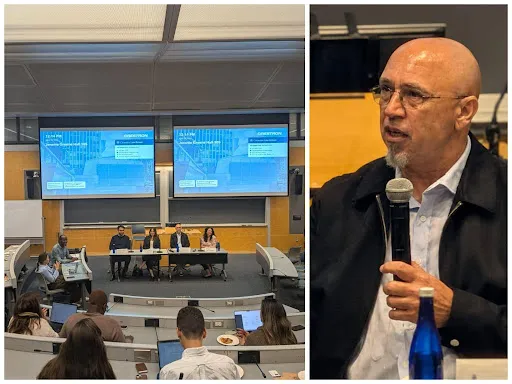
Christopher Rutledge of the 2025-26 cohort of the Human Rights Advocates Program (HRAP) joined a Columbia Law School panel on 28 April 2026 reflecting on pathways into human rights work, drawing on three decades of grassroots organizing in South Africa. Rutledge serves as Executive Director of Mining Affected Communities United in Action and Women Affected by Mining United in Action Advice Office.
The lunchtime conversation, convened by Columbia Law School's Human Rights Institute in Jerome Greene Hall and moderated by Clinton Nyamongo, LLM'26, brought together four practitioners at different stages of their careers. It drew students approaching the close of their degrees who were weighing whether to commit themselves to public interest and human rights work, and became less a conventional careers event than a reflection on what it means to sustain a vocation of justice in conditions of shrinking funding and persistent grassroots crisis.
Nyamongo opened by framing the discussion as an attempt to bridge the gap between the classroom and the practice itself. The panel comprised Tejal Jesrani, Acting Director of the Human Rights Institute, Alice Gardoll, Director of Legal Strategy and Impact at the Clooney Foundation for Justice, Rutledge, and Nawid Ahmad Cina, LLM'26, recipient of Australia's 2022 Human Rights Medal for his leadership during the 2021 Afghanistan evacuation effort.
Rutledge provided the panel's most overtly political narrative, pinpointing three formative experiences. His initial spark of compassion arose in primary school as a response to being bullied. During his early teens, witnessing the apartheid state's brutality against student activists propelled him into the resistance; consequently, he was pursued by security forces from age fourteen, detained at sixteen, and subjected to nine months of solitary confinement. Finally, in the post-apartheid era, he resigned from a corporate directorship, concluding that the prevailing corporate ethos fundamentally clashed with his core human rights values.
Asked to highlight defining work, Rutledge pointed to the deaths of 93 Black migrant mineworkers, who were starved between late 2024 and early 2025 while trapped two to three kilometres underground at an abandoned mine. His organization fought through successive court challenges as the police and the state misled the judiciary. When the High Court finally authorized the intervention the state itself refused to undertake, the affected community improvised ropes and a pulley system to bring survivors back to the surface, an operation taking roughly 40 minutes per person. Bodies eventually followed. Interviewed live on television after the legal victory, Rutledge recounted how he broke down at the indifference shown to men the social order has rendered expendable. It is this everyday injustice, he said, that continues to animate his work.
The other panellists offered complementary accounts. Jesrani traced an overdeveloped sense of justice from high school feminism through a 16-year career at the United Nations Office on Drugs and Crime that, in the end, did not satisfy her. Her central lesson, she told students, was that "red lights that people use to stop you, are also a way to figure out what you should do." Gardoll, who witnessed proceedings of the Rwanda tribunal as a teenager in Tanzania, described an arc from Australian corporate practice through asylum work on Samos and public defense in remote First Nations communities to current strategic litigation supporting Filipino Nobel laureate Maria Ressa and contributing to the ICC arrest warrant against Benjamin Netanyahu. Cina recounted coordinating the evacuation of roughly 130 staff, orphans, and widows from Afghanistan after the Taliban's return. Civil society, he argued, must learn to translate moral reality into the procedural language a bureaucracy understands.
Nyamongo closed by combining two final questions: how the panelists had navigated the theory–practice gap, and what advice they would give students entering the field amid donor retreat. Rutledge's response cut against the grain of the careers framing. "If you are entering human rights work as a career, I would suggest you stay out," he said. The work, he argued, must be something a person is intrinsically connected to, grounded in compassion rather than in the prospect of earning a living. Those passing the time, he said plainly, would find better things to do elsewhere.