
HRAP Advocates Share Lessons Learned on Organizing in Dangerous Times
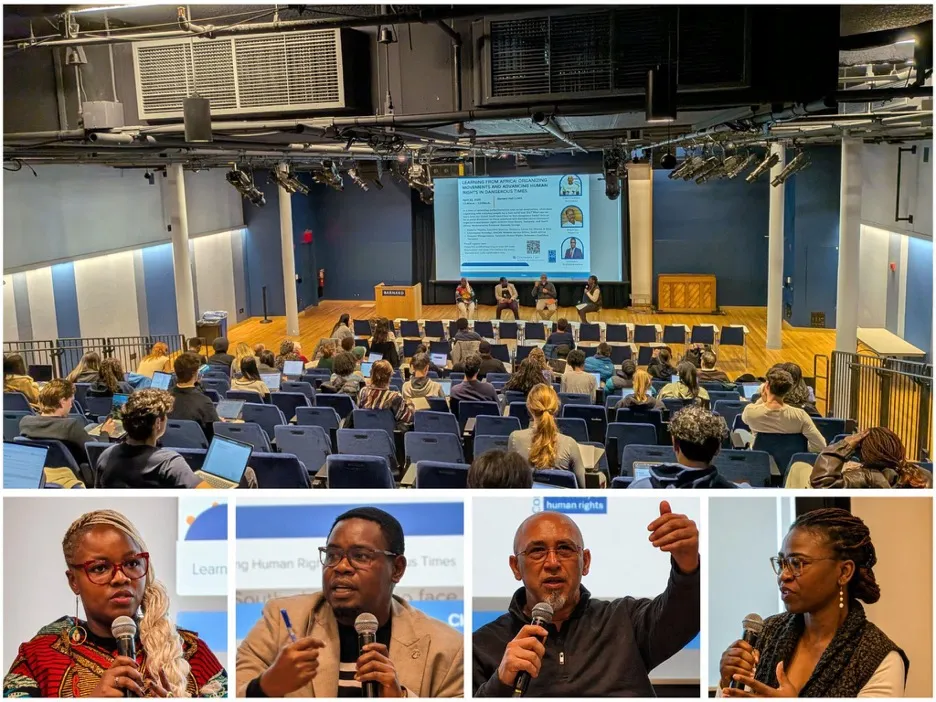
As civic space narrows across much of the world and social movements contend with state repression, rising surveillance, and the fraying of community life, what can the Global South offer those seeking to organize for a more just future? That question animated a panel discussion at Barnard College on April 22, where three participants in Columbia University's Human Rights Advocates Program (HRAP) shared lessons drawn from their work in Kenya, Tanzania, and South Africa.
Convened by the Institute of African Studies and the Institute for the Study of Human Rights, the event titled "Learning from Africa: Organizing Movements and Advancing Human Rights in Dangerous Times" was moderated by Professor Abosede George, Tow Associate Professor of History and Africana Studies at Barnard College and Columbia University, also currently serving as Director of the Institute of African Studies at Columbia University. Professor Abosede framed the discussion within the longer arc of African anti-colonial history, inviting the panelists to reflect on the vision that contemporary movements are working to realize.
Nyawira Wahito, Executive Director of Kenya's Resource Center for Women and Girls and a current HRAP fellow, described the 2024 femicide protests that saw women mobilize across all 47 Kenyan counties (states/ provinces) after a civil society database, launched by Odipodev and the Africa Data Hub, recorded more than 500 names of women killed by men. She recounted how the demonstrations were organized through social media and led by young women who resisted political co-optation. Reflecting on the subsequent Reject Finance Bill protests, in which more than 60 young people lost their lives and women protesters reported experiencing sexual violence, Wahito spoke of the need to help young activists channel their anger constructively. "Sometimes when you're angry, if you don't use it constructively, it can be destructive and end up biting you," she said.
Onesmo Olengurumwa, who leads the Tanzania Human Rights Defenders Coalition, a network of more than 300 organizations, reflected on the aftermath of Tanzania's October 2025 general election, during which significant loss of life was reported, the internet was shut down for nearly ten days, and more than 2,000 people were arrested. His coalition has since supported the release of roughly 90 percent of those detained and published a report titled "Reimagining the State of Civic Space." Olengurumwa situated these developments within a broader pattern. "Look at how the marriage between autocratic leaderships, militarizations, the capitalisms and other related issues like technology, the corporate world are working into that sort of alliance just to squeeze the space, to squeeze the dissent, to squeeze the democracies," he observed, calling for cross-border solidarity among human rights actors across the Global South and North.
Christopher Rutledge of South Africa's MACUA WAMUA Advice Office recounted the 2024 to 2025 tragedy at Stilfontein, where 93 young Black artisanal miners died underground over nearly a year following a state operation against informal mining. He also discussed Anglo American's withdrawal from South Africa, describing the company's long role in the country's extractive economy and the inequalities that legacy continues to produce. Drawing on the Charterist tradition that shaped South Africa's 1955 Freedom Charter, Rutledge argued that grassroots movements benefit from a shared vision in order to avoid what a South African scholar has called "the smoke that calls," where communities rise in anger only to dissipate without durable change. His organization has developed a People's Mining Charter in response. Rutledge emphasized the importance of collective organizing. "The only way we can bring that together is through movement," he said. "So we build movements on the ground based on a shared vision around which we can articulate a struggle and advance an agenda."
A central thread ran through the conversation. African organizing traditions, rooted in communal ownership, collective learning, and intergenerational mentorship, offer resources for sustaining the collective bonds that market individualism has steadily weakened. Olengurumwa reflected on how colonialism disrupted communal ways of life, shifting African societies toward individual self-interest, and encouraged a renewed engagement with African epistemologies as a foundation for contemporary advocacy. Rutledge echoed the point, observing that contemporary society often demands immediate results and moves on when change does not come quickly, and making the case for the slower, relational work of door-to-door movement building.