
HRAP Advocates Champion Black Women's Futures at Columbia Forum
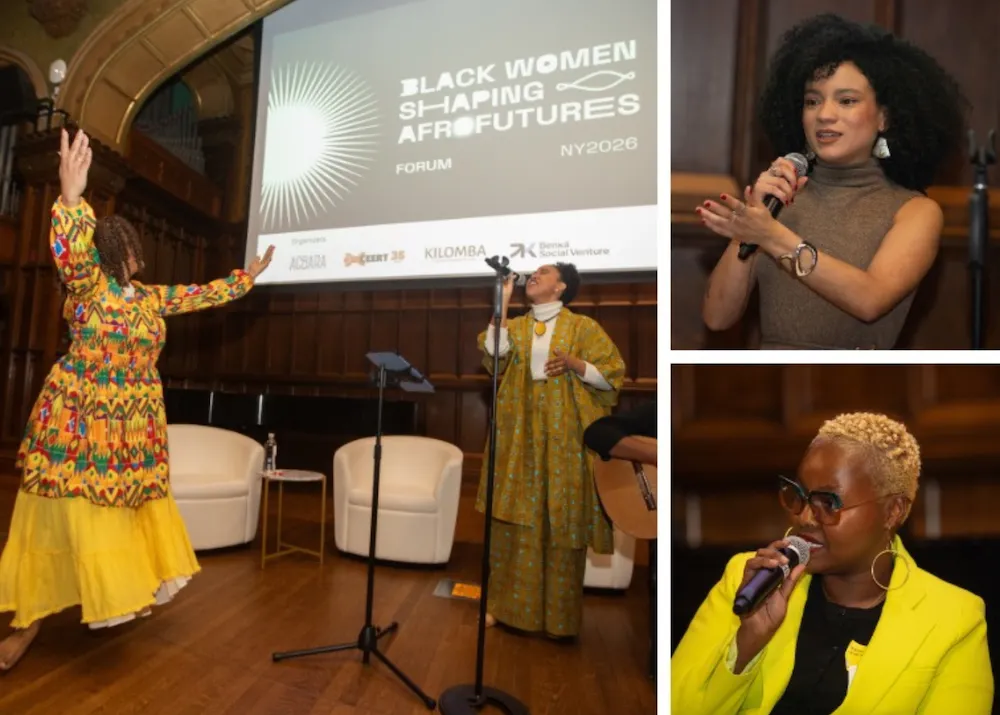
Two participants in Columbia University's Human Rights Advocates Program (HRAP) played central roles in a recent forum examining transnational solidarity, economic justice, and the well-being of Black women and girls from the Global South and the African diaspora.
On March 11 and 12, the third edition of the Black Women Shaping Afrofutures Forum convened at Columbia's Teachers College, bringing together activists, scholars, artists, and policymakers to turn political imagination into actionable strategy. The event focused on racial, gender, economic, and climate justice, centering voices from communities most affected by these intersecting systems of oppression.
Júlia Mota, an Advocacy Specialist at Brazil's Fundo Agbara and a 2025-2026 HRAP fellow, served on the forum's organizing committee. Júlia's work at Fundo Agbara focuses on economic justice for Black women and creating spaces for women from the African diaspora to debate historical reparation and imagine alternative futures. Her role in designing the forum reflected nearly two years of international project work addressing systemic extraction of labor and resources from Black women.
“Black Women Shaping Afrofutures emerged from a question that resonates with many of us, black women from the Global South: the extreme bureaucratization of institutional spaces within multilateral mechanisms. While these spaces have been important for political coordination around development processes, they continue to maintain barriers to the participation of Black women, particularly those from the Global South, in organizing and leading parallel events. In this context, BWSA was created as a space of resistance, but it does not end there. This international forum, built by a committee of organizations, seeks to foster solidarity, collective construction, shared dreaming, and radical imagination.”
Nyawira Wahito, Executive Director of Kenya's Resource Center for Women and Girls (RCWG) and also a current HRAP fellow, spoke on the panel "Buen Vivir: Black Women and Girls Building Futures." Wahito has spent nearly 13 years nurturing leadership among girls in rural Kenya, focusing on education, health, and economic empowerment in communities where systemic marginalization limits opportunities for young women.
During the panel, Wahito challenged the "strong Black woman" narrative—the expectation that Black women prove their value through endurance and suffering. "We have to shed the notion of the strong black woman. It has to go," she said. "We also have to reclaim wellness. We have to reclaim joy. We have to reclaim and redefine well-being from a goal to a human need."
Wahito argued that rest itself functions as resistance in systems designed to extract labor without compensation. "Rest is radical. It's a radical act in and of itself," she explained. "The resting here is beyond the physical act of resting. It is about resting from a system that continues to burden us with oppression."
The forum brought together participants from across Africa and the African diaspora in the United States, Latin America and the Caribbean to examine how colonial histories, economic extraction, and racial capitalism create common conditions requiring collective response. Organizers designed the event to foster strategic dialogue and collaborative action rather than simply sharing testimonies of harm.
Both advocates emphasized that movements for justice must center the well-being of those most marginalized—not as a future goal but as an immediate standard. Their work at the forum demonstrated how transnational solidarity among Black women and girls can reshape conversations about justice, moving from narratives of victimhood to visions of collective power and self-determination.