
Columbia's Human Rights Advocates Program Bids Farewell to Its 2025-2026 Cohort
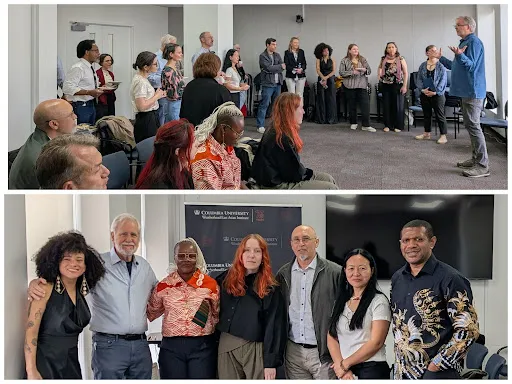
Seven HRAP advocates from Belarus, Brazil, India, Indonesia, Kenya, South Africa, and Tanzania closed their fellowship at a farewell reception hosted by ISHR at Columbia University on Wednesday, April 29, 2026.
Joseph Slaughter, Director of the Institute for the Study of Human Rights (ISHR) at Columbia University, opened the reception. He was followed by Stephanie Grepo, Director of Capacity Building, and by Nazibrola Janezashvili, an HRAP alumnus of the 2009 cohort. The seven outgoing fellows then offered their closing reflections to faculty, staff, mentors, and HRAP alumni gathered in the room.
Providing a concise history of HRAP, Slaughter in his introductory remarks noted that ISHR has hosted the program since 1989. Slaughter framed its enduring operation as a meaningful response to the current challenges facing human rights work. He characterized the participants (past and present) as individuals who were performing remarkable work prior to their arrival and have achieved even greater impact since. "I am very proud that we've somehow managed to persist with this," Slaughter said, also broadly pointing to the undergraduate major, the graduate program, and the advocates themselves as the means by which ISHR continues "to educate the next generation of people in the world to study and to advocate for human rights."
Expressing gratitude to the advocates for committing four months of their lives to the initiative, Grepo remarked, "You leave your homes, your jobs, your families, and you trust us to deliver in this program, and we hope that we did deliver for you." She extended her thanks to the faculty mentors, workshop instructors, the International Students and Scholars Office, and Public Safety and with a specific mention of Brooke Blackburn, the work-study student who has assisted HRAP for two years. Highlighting the alumni network as an enduring support system, Grepo noted that former participants "always reach out when they're in New York, they send updates to us, and they let us know what's going on, even when things aren't well." Following these remarks, she invited Janezashvili to address the group.
Janezashvili, who most recently founded Georgia Court Watch and also served from 2017 to 2021 as the only non-judge member of Georgia's High Council of Justice (the entity responsible for nominating judicial candidates to Georgian parliament), spoke to the incoming alumni. Having departed Georgia following the enactment of laws that restricted civil society activities, she emphasized that the program's impact would be lasting. Janezashvili told the cohort, "These friendships you built, the knowledge you gained, and the values you strengthened will guide you wherever life takes you."
The seven outgoing advocates then took the floor in turn, each offering their own reflection on what the program had been.
Reflecting on the bonds formed within the group, Tatsiana Ziniakova highlighted the cohort's evolution into a supportive network. She individually recognized her colleagues, characterizing the fellowship as a system of "alternative kinships" established by those living away from their homelands. "As someone who has been away from my homeland of Belarus for a while, I observe how people away from home tend to create these alternative kinships and support systems," she noted. Ziniakova concluded her thoughts by describing the unique dynamic of the group, stating, "Sometimes you experience peer pressure, but sometimes you experience peer pleasure".
Reflecting on her time in the program, Júlia Mota observed that while she began the fellowship with firmly established perspectives, the four-month journey subtly shifted and broadened her outlook, allowing previously settled insights to finally become fully integrated. Mota noted that the experience bolstered her determination, suggesting that when large-scale systemic transformation appears unattainable, the most essential task is protecting the shared spaces of one's community. "Even when we cannot transform everything, nothing takes away the power of beholding our territories with our communities. I refuse the idea that we are powerless," she maintained.
Maiya Shang characterized her four-month stay in New York as a period defined by intense activity, unfamiliar winter weather, and a profound sense of fulfillment. She reflected on how the program's various elements—the seminars, workshops, and communal time with the cohort—effectively reinforced one another, allowing her to integrate academic readings directly into her organizational efforts. "All the sessions I attended, all the networking that I do, and all the time I spent with the fellow cohort, all of them complemented each other," Shang observed. Regarding the bond shared by the group, she concluded, "The journey that we have had together, it's not only a learning experience, but it's also a very memorable one that we will continue to hold with us in the days to come".
Ronald Rohrohmana noted that his arrival in January coincided with a period of significant contraction in the field, as organizations and advocates throughout the Global South navigated the challenges of diminishing civil society funding. Within this environment, Rohrohmana characterized HRAP as more than just a program, describing it as a sanctuary. He remarked, "Thank you for building this sanctuary for advocates. The quiet care that holds this program together is itself a form of human rights work". Reflecting on the bond formed within the group, he added, "We came from seven countries and arrived as strangers, we're leaving as something closer to family".
Nyawira Wahito characterized the program as a comprehensive ecosystem where every element, from academic classes and workshops to networking and mentorship, played a vital role. She observed that, throughout her four-month stay in New York, the presence of a reliable community was a persistent factor, even amidst the distance from her home and the unaccustomed cold. Wahito identified this community as the essential support that sustains advocates through the rigors of their work. She remarked, "It's the pressure to do what's right, the pressure to keep going, the pressure to keep moving and the pressure to hang in there, even as the world is on fire".
Christopher Rutledge explained that he joined the program after a deeply painful time following the death of his son and an extended period where his professional duties had almost completely overshadowed his connection to community. Reflecting on his four-month tenure at HRAP, Rutledge observed that the experience revitalized this part of his life, characterizing the cohort as an essential support network he had not realized he was missing. He noted, "This program has really changed that for me, it's opened me up to the importance of building connection and community and networking".
Onesmo Olengurumwa provided the final remarks for the cohort, identifying the program for human rights practitioners as an opportunity to engage with academic discourse that often remains separate from practical field work. He noted the frequent lack of integration between real-world issues and scholarly study, stating, "Sometimes we do a lot on the ground, missing that connectivity between the real-time problems on the ground and what is happening in an academic field." Olengurumwa concluded with an appeal to the Institute to ensure HRAP’s longevity, urging, "Keep on doing this. You should not let this program get out of here."
Upon completing their fellowship at Columbia University, the 2025-2026 HRAP cohort joins a vast global network of more than 350 alumni across nearly 100 nations. They depart equipped with enhanced professional tools and the support of a worldwide community. As one advocate expressed in his concluding address, that while their path as human rights advocates may be difficult and enduring, they will never have to face it in isolation.