
Advocates in Their Own Words: Maiya Shang on Indigenous Women's Rights, from Manipur to the UN
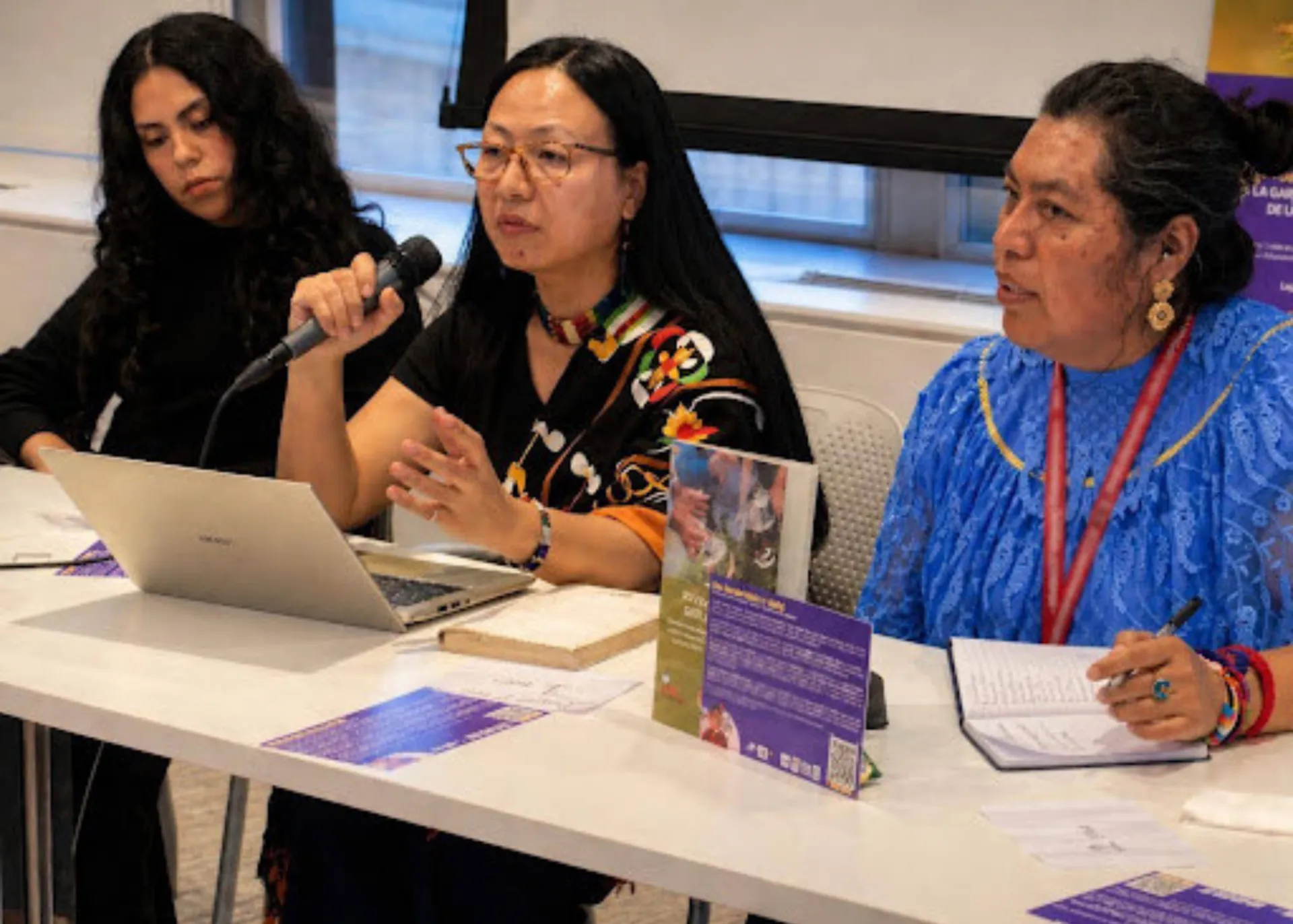
This is the first in a series of profiles of the Advocates in our 2025-2026 cohort, written in their own voices. We begin with Maiya Shang, Asia Pacific Grants Coordinator at the International Indigenous Women's Forum (FIMI), who has spent this spring as an HRAP Advocate at Columbia while attending her first session of the United Nations Permanent Forum on Indigenous Issues.
The twenty-fifth session of the Forum, running at UN Headquarters from 20 April to 1 May, has taken as its theme ensuring Indigenous peoples' health in the context of conflict. For Maiya, that framing is not theoretical. It is the framing she has been working inside, in one form or another, for most of her life.
Maiya is a Tangkhul Naga, raised in a town in Nagaland, a neighboring state to her ancestral village in Manipur, in the years before the 1997 ceasefire between the Government of India and the National Socialist Council of Nagaland. Militarization, she says, is not something she studies. It is something she grew up inside. "The military came to the village. They gathered everyone in the ground, and they were tortured for a long time. Sometimes they would just let them stand there for the whole night." An uncle of hers walks with a permanent limp from one such night.
One incident she remembers with particular clarity happened on a Sunday. The churches in her town let out around the same time, and most of the congregation walked home along the main road. A long army convoy was passing through when one of its tires burst. In the confusion, and for reasons she still does not know, the soldiers opened fire. "They literally fired everywhere, just blindly," she recalls. She and the others on the road dove for cover and crouched there for the length of the firing and mortar shelling, which lasted for about two hours. "I was also at the main road, and we had to take refuge just under the road, and we could hear shouting and firing going on."
A total of seven civilians were killed in the incident, including a three and half year-old child, many were injured, tortured and left with permanent trauma. There was an investigation on the incident but there was no justice because the army had impunity under the Armed Forces Special Power Act (AFSPA). It is one of the most draconian acts in the world that has been effective in our place since 1958.
"Whether you like it or not," she said, "you just grow up in that. These kinds of things are always there, at the back of your mind."
Her route from that childhood to a multilateral career ran through Delhi, where she spent nearly a decade in content development and editing before moving fully into Indigenous advocacy. Those years, she is careful to say, were not a detour. They taught her how ordinary Indian friends and colleagues perceived, or more often failed to perceive, the northeastern indigenous people like herself. They also exposed her to daily discrimination of a different grade, from vegetable vendors who doubled the price at the sight of her face (which differs from the majority of Indians) to the routine harassment that Naga women in the National Capital Region absorb on buses and at workplaces. She still remembers spending a night at a police station in Gurgaon (a suburb close to the capital) with fellow community organizers, demanding that a complaint be registered for a Naga woman who had been harassed by her employer. "The discrimination is there," she said, "but it is also from structural barriers, because our history and our reality are not taught anywhere in the education system." It is, she believes, what eventually pushed her into full-time advocacy work.
Based in Thailand, she now coordinates FIMI's Grants for Asia-Pacific region, supporting Indigenous women's organizations across regions where, she observes, the particulars of each struggle can obscure what advocates hold in common. "Often we work in our own specific areas, and we tend to think that what we have is the biggest issue," she said. "The main thing I want to go back and tell them is how different Indigenous Women, in different parts of the world, face similar issues as well as specific issues of their own regions, and that we can learn from each other."
On 22 April, she sat on a UNFPII side-event panel organized by the Coordinadora Nacional de Mujeres Indígenas and the Robert and Ethel Kennedy Human Rights Center to discuss Ascencio Rosario v. Mexico, the December 2025 Inter-American Court judgment concerning a 73-year-old monolingual Nahua woman sexually assaulted by members of the Mexican Army in 2007 and later died of her injuries. "My presentation was about how the barriers highlighted in this significant ruling are relevant for Indigenous Women in all parts of the world," she told us. Lack of interpreters, a health system that fails culturally and linguistically marginalized patients, the protection of perpetrators by state officials: these, she argued, are not parochially Mexican facts. They travel. "In different regions of the world, different Indigenous Women face similar issues. Some might be distinct, but we can learn from each other and advocate together."
Being in New York as an HRAP Advocate, rather than flying in for the two weeks of the Forum, has been very helpful. "The fact that I am already here is a big privilege," she said. "For Indigenous Peoples, there are many barriers to attending such platforms. There is the visa barrier. There is the ECOSOC registration, with limited slots. There is the question of financing. And these days, with the situation of the world, even thinking about traveling is stressful." Her months at Columbia, she added, have given her "a broader framework" for reading what happens in the Forum's main hall and side events.
She is clear-eyed about what that hall can and cannot deliver. Asked what she made of the Forum's likely recommendations, due on 1 May, she was candid. "I'm a little skeptical. Every year it happens. It's not that all the hard work has not borne fruit. We have the UN Declaration on the Rights of Indigenous Peoples. We have CEDAW General Recommendation 39 on Indigenous women. But the achievements on the ground are small and very slow. That doesn't mean we give up. Even though our victories are small and slow, like the ruling on Ascencio Rosario, these small but significant victories are what give us hope to continue."
We asked her, finally, what she would say to the next generation of Indigenous young people who might read this, those who might one day find themselves working in the fields she has spent her career inside or taking part in programs like HRAP. "Come with an open mind to learn," she told us. "If you stay only with your own issues, you will not be able to learn."
–
Advocates In Their Own Words is a series profiling fellows and alumni of Columbia University's Human Rights Advocates Program.