
Maurice J. and Fay B. Karpf Peace Prize Award
The Karpf Peace Prize Award was established through a bequest from the estate of Fay Karpf. It recognizes an ISHR student for their work “involving original contributions to the subject of the promotion of universal peace, goodwill, tolerance, and understanding among the peoples of the earth.” M.A. and undergraduate students currently enrolled in an ISHR degree program are eligible to apply.
There are two tracks for this award - the academic track and the internship, volunteer, or study abroad track. For the academic track, the selection committee will consider projects that are academic in nature, including projects carried out under the guidance of Columbia faculty. For the second track, the selection committee will consider projects undertaken during an internship, volunteer, or study abroad placement.
For both tracks, selected students produce a substantive piece of writing (five pages minimum) and commit to sharing their work with the ISHR community (e.g. presenting at an event or participating in a poster board session) upon completion of the project. Only returning students are eligible to apply. Award recipients will receive a stipend in the amount of up to $5,000. There are two separate applications: the academic track application and the internship, volunteer, or study abroad track application.
2026 Winners
Shirine Daghmouri

Shirine Daghmouri is entering her fourth year at Columbia in the Dual-BA program where she studies Human Rights with a specialization in Economics, and Political Science. As part of the Dual-BA, Shirine majored in Politics and Government at Sciences Po Paris in Menton, France, specializing in the Middle East region. During her two years at Sciences Po, Shirine worked as a Finance and Partnerships Chair for an international research association, interned at government offices, and worked at a Social Enterprise in Tunisia on projects to support artisan labor.
Through the Karpf Prize, Shirine is working as a research intern at the Care and Protection of Children (CPC) Learning Network at Columbia University's Mailman School of Public Health, where she supports a portfolio of global research projects. Her work spans qualitative and quantitative data analysis across various projects addressing child labor; child and adolescent mental health among refugee populations; and art-based education curricula.
Adanur Nas

Adanur Nas is a rising junior at Columbia University, majoring in Economics–Political Science and Human Rights. Originally from Diyarbakir, Turkiye, she is interested in understanding how human rights, political economy, institutional accountability, and peacebuilding interact and support one another. Having grown up in a region affected by conflict and political repression, her academic and professional work focuses on how governance systems, public institutions, and accountability mechanisms shape access to rights, public trust, and democratic participation.
As a Research Assistant in Columbia University's Department of Political Science, Adanur studies how social media influences youth political behavior, civic engagement, and democratic accountability. Her previous research has examined Kurdish nationalism and minority rights, corporate accountability for human rights abuses, international climate accountability and justice, and the political consequences of institutional weakness in conflict-affected regions. She is also a member of the Chalkboard Politics Podcast team at the Saltzman Institute of War and Peace Studies and is actively involved in campus organizations, including the Columbia Undergraduate Law Review, Columbia Academics in Foreign Affairs, and the Columbia Taekwondo Club. Beyond campus, she has contributed to policy and public-interest initiatives in the United States, Austria, and Turkiye.
As a recipient of the Maurice J. and Fay B. Karpf Peace Prize Award, Adanur is spending her summer at the International Anti-Corruption Academy in Austria as an Academic Programmes Intern. Her project examines the relationship between corruption, institutional accountability, socio-economic rights, and peacebuilding by particularly focusing on how anti-corruption education can strengthen public trust and support more inclusive and peaceful societies.
Chantel Hover
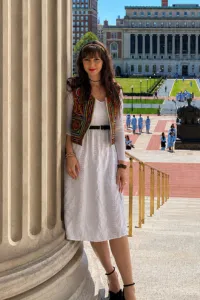
Chantel Hover is a first-generation college student pursuing an M.A. in Human Rights Studies within the Institute for the Study of Human Rights at Columbia University. As a non-traditional student, she has worked in a variety of fields, including fashion, refugee-focused nonprofits, childcare, and higher education, while pursuing and after completing a B.A. in Political Science with a focus on international relations and human rights.
Much of Chantel's human rights work has centered on expanding educational access for marginalized communities. She previously served as Youth Exchange Program Coordinator at Paper Airplanes, a nonprofit that provides educational opportunities for refugees and displaced persons across the MENA region. She has volunteered in refugee resettlement and education programs and contributed to a U.S. Department of State-funded project focused on disability inclusion in the Ukrainian school system. More recently, she has engaged in initiatives supporting Indigenous participation in international human rights forums.
At Columbia, Chantel serves as Co-Director of Outreach for the Human Rights Graduate Group and leads the Afghan Mentorship Program with the Afghan Student Alliance. Through her studies at ISHR, she has expanded her interest in educational inequality to broader questions of socioeconomic inequality, access to justice for marginalized populations, and human rights protection.
With the support of the Karpf Award, Chantel will intern this summer with the Office of the United Nations High Commissioner for Human Rights (OHCHR) in Ecuador, contributing to a project supporting public policy development for the protection of human rights defenders, environmental defenders, and journalists. She is grateful for the opportunity to contribute to this work and deepen her understanding of human rights advocacy in practice.